Preamble
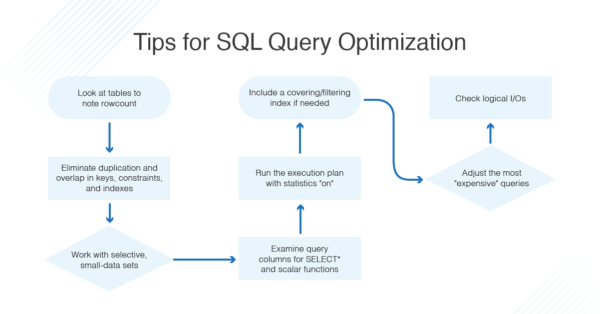
15 simple tips for action that will help you learn to write the right queries in SQL:
Optimization of tables
Necessary when many changes have been made to a table: either removed most of the data, or a lot of changes with strings of variable length – text, varchar, blob. The point is that the deleted records continue to be supported in the index file, and the subsequent insertion of new records uses positions of the old records. To defragment a file with data, the OPTIMIZE command is used.
OPTIMIZE TABLE `table1`, `table2`
Do not forget that during optimization, access to the table is blocked.
Restructuring data in the table
After frequent changes in the table, this command can improve the performance of working with data. It rearranges them in the table and sorts them by a certain field.
ALTER TABLE `table1` ORDER BY `id
Data type
It is better not to index fields that have string type, especially fields of TEXT type. For tables whose data change frequently, it is desirable to avoid using fields of the VARCHAR and BLOB types, as this type creates a dynamic string length, thus increasing the time of data access. In this case, it is recommended to use the VARCHAR field instead of TEXT, as it is faster to work with.
NOT NULL and the field by default
It is best to mark the fields as NOT NULL, as they save a little space and exclude unnecessary checks. At the same time, you should set the default field value and insert new data only if they differ from it. This will speed up the addition of data and reduce the time for table analysis. And you should keep in mind that BLOB and TEXT field types cannot contain default values.
Permanent connection to the database server
Allows you to avoid wasting time on reconnecting. However, it should be remembered that the server may have a limit on the number of connections, and if the site traffic is very high, the permanent connection can play a bad joke.
Data separation
Long not key fields advised to separate in a separate table if the original table is a constant sample of data and which changes frequently. This method will reduce the size of the variable part of the table, which will reduce the search for information.
It is especially relevant in cases when part of information in the table is intended for reading only, and the other part – not only for reading, but also for modification (do not forget that when you write information the whole table is blocked). A vivid example is attendance counter.
There is a table (name first) with fields id, content, shows. The first key with auto_increment, the second – text, and the third numerical – counts the number of hits. Each time you load a page, the last field is added +1. Let’s separate the last field into the second table. So, the first table (first) will be with the fields id, content, and the second (second) with the fields shows and first_id. The first field is clear, the second I think, too – referred to the key field id from the first table.
Now constant updates will take place in the second table. It is better to change the number of visits not programmatically, but through a query:
UPDATE second SET shows=shows+1 WHERE first_id=necessary_id
And the sample will be a complicated request, but one, two is not necessary:
SELECT first.id, first.content, second.first_id, second.shows FROM second INNER JOIN first ON (first.id = second.first_id)
It is worth remembering that this is not very relevant for sites with low attendance and little information.
Field names
For example, two tables are linked, preferably with the same name. Then simultaneous reception of the information from different tables through one inquiry will occur faster. For example, from the previous point, it is desirable that in the second table the field be named not first_id, but simply id, similar to the first table. However, if the name is the same, it is not very clear what, where and how. So the advice is for the amateur.
Require less data
If possible, avoid type requests:
SELECT * FROM `table1'
A query is not effective because it most likely returns more data than is necessary for the job. Optionally, the design is better:
SELECT id, name FROM table1 ORDER BY id LIMIT 25
Immediately I will make an addition about the desirability of using LIMIT. This command limits the number of lines returned by the request. That is, the request becomes “lighter”; and more productive.
- If LIMIT is 10, then after receiving ten lines the request is interrupted.
- If ORDER BY sorting is used in the query, it does not occur for the whole table, but only for the sample.
- If LIMIT is used in conjunction with DISTINCT, then the query will be aborted after the specified number of unique rows is found.
- If you use LIMIT 0, an empty value will be returned (sometimes needed to determine the field type or just to check the query).
Limit the use of DISTINCT
This command excludes repetitive strings as a result. This command requires an increased processing time. It is best to combine with LIMIT.
There is a little trick. If you want to view two tables on the subject of a match, this command will stop as soon as the first match is found.
SELECT DISTINCT table1.content FROM table1, table2 WHERE table1.content = table2.content
Do not forget about temporary HEAP tables
Although the table has limitations, it is convenient to store intermediate data in the table, especially when you need to make another sample from the table without reusing it. The point is that this table is stored in memory and therefore access to it is very fast.
Search by template
It depends on the size of the field and if you reduce the size from 400 bytes to 300, the search time is reduced by 25%.
Command LOAD DATA INFILE
Allows you to quickly upload large amounts of data from a text file
Storing images in the database is not desirable
It is better to store them in a folder on the server, and in the database to store the full path to them. The fact that the web server caches graphics files better than the content of the database, which means that when you subsequently access the image, it will display faster.
Maximum number of requests during page generation
I think there should be no more than 20 (+- 5 requests). At the same time, it should not depend on variable parameters.
About Enteros
Enteros offers a patented database performance management SaaS platform. It proactively identifies root causes of complex business-impacting database scalability and performance issues across a growing number of clouds, RDBMS, NoSQL, and machine learning database platforms.
The views expressed on this blog are those of the author and do not necessarily reflect the opinions of Enteros Inc. This blog may contain links to the content of third-party sites. By providing such links, Enteros Inc. does not adopt, guarantee, approve, or endorse the information, views, or products available on such sites.
Are you interested in writing for Enteros’ Blog? Please send us a pitch!
RELATED POSTS
How to Optimize Aviation Operations with Enteros Database Software, AI-Powered Analytics, and Operational Intelligence
- 17 July 2026
- Database Performance Management
Introduction The aviation industry is one of the most data-intensive sectors in the world. Every day, airlines, airports, cargo operators, and aviation service providers process millions of transactions involving flight reservations, passenger check-ins, baggage handling, aircraft maintenance, crew scheduling, air traffic coordination, cargo logistics, loyalty programs, and financial operations. As passenger demand continues to grow … Continue reading “How to Optimize Aviation Operations with Enteros Database Software, AI-Powered Analytics, and Operational Intelligence”
How to Optimize Oil and Gas Operations with Enteros Database Software, Predictive Analytics, and Operational Intelligence
- 16 July 2026
- Database Performance Management
Introduction The oil and gas industry is undergoing a major digital transformation as companies adopt cloud computing, Industrial IoT (IIoT), artificial intelligence (AI), predictive maintenance, and real-time analytics to improve operational efficiency and profitability. From upstream exploration and drilling to midstream transportation and downstream refining, every stage of the energy value chain depends on reliable … Continue reading “How to Optimize Oil and Gas Operations with Enteros Database Software, Predictive Analytics, and Operational Intelligence”
How to Optimize Higher Education Technology with Enteros Database Software, Operational Intelligence, and AI-Powered Analytics
Introduction Higher education institutions are experiencing rapid digital transformation. Universities and colleges are investing in cloud technologies, online learning platforms, student information systems, artificial intelligence, learning analytics, research computing, and digital campus initiatives to improve educational outcomes and operational efficiency. Every interaction within a modern university generates data. Student admissions, enrollment, learning management systems (LMS), … Continue reading “How to Optimize Higher Education Technology with Enteros Database Software, Operational Intelligence, and AI-Powered Analytics”
The Business Value of Combining AIOps, FinOps, and AI-Powered Database Performance Management
Introduction Digital transformation has fundamentally changed how organizations build, deploy, and manage applications. Enterprises across banking, healthcare, retail, manufacturing, telecommunications, and education now rely on cloud-native architectures, microservices, hybrid cloud environments, and distributed databases to deliver always-on digital experiences. While these technologies provide scalability and flexibility, they also introduce new operational challenges. Organizations face increasing … Continue reading “The Business Value of Combining AIOps, FinOps, and AI-Powered Database Performance Management”