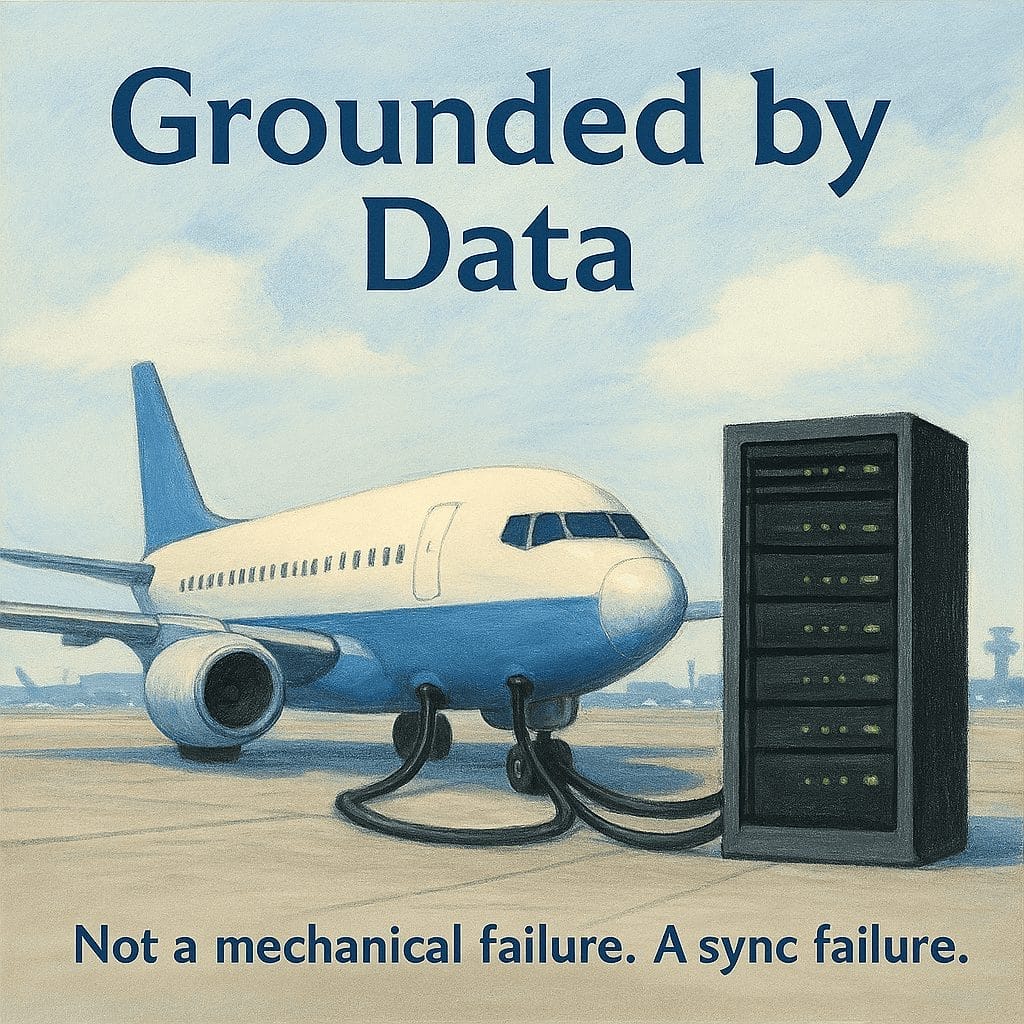
When Alaska Air grounded flights after a failure in its primary data center, it looked like a classic IT outage.
But behind the headlines was a more modern truth:
operations now depend on data performance as much as on hardware reliability.
In aviation, a single database delay can cascade through thousands of dependencies — from ticketing to crew management to maintenance scheduling — freezing an entire network even when the planes themselves are ready to fly.
And this isn’t just an airline problem.
It’s the same risk facing manufacturers, logistics providers, and utilities — any industry where real-time data feeds critical operations.
The Hidden Cost of Downtime: When Data Becomes the Bottleneck
The Alaska Air incident wasn’t caused by hackers or power failures — it started with latency.
When systems that track aircraft, crew, and passengers stop syncing correctly, the digital version of the airline splinters.
Here’s how the cascade unfolds in less than an hour:
-
A flight schedule update fails to replicate from the operations database to the booking system.
-
Passengers receive outdated gate information.
-
Maintenance checks are logged but not confirmed in the central record.
-
Crew rotations can’t be verified.
Result: thousands of people stranded — not because of weather, but because databases fell out of sync.
Now imagine this happening in logistics: a retailer’s warehouse system updates orders every 30 minutes instead of 3.
By the time a delay is detected, products have already been loaded onto the wrong trucks.
In one case study from a European distributor, a 9-minute replication lag in SQL data led to $1.8M in inventory misalignment over a weekend.
That’s the hidden cost of slow data.
Why Redundancy Isn’t Enough Anymore
Many companies believe their “backup strategy” protects them from disruption.
But there’s a growing misunderstanding between data recovery and data continuity.
A backup gets you your data back.
It doesn’t guarantee your systems stay synchronized in real time.
Enterprise databases now operate in hybrid environments — on-prem, cloud, multi-cloud — with tens of thousands of queries running per minute.
When latency spikes in one region, APIs waiting on that data begin to stall.
Machine learning systems trained on that data start to drift.
And dashboards built for executives show yesterday’s numbers, not today’s reality.
Performance degradation becomes a silent outage.
That’s what Alaska Air — and many others — are now learning the hard way.
⚙️ The Rise of Data Performance Engineering
Forward-thinking organizations are already changing how they approach resilience.
They no longer ask, “How fast can we recover?”
They ask, “How fast can we detect degradation — and stop it before it spreads?”
This shift has led to the rise of data performance intelligence — a discipline focused on identifying inefficiencies across massive database environments.
For instance:
A North American carrier recently implemented proactive workload analytics across its SQL clusters.
By continuously monitoring response time anomalies, they detected query-level slowdowns days before users felt any impact — reducing outage risk by 68%.
Another logistics firm used AI-assisted database performance tuning to redistribute traffic loads during seasonal surges.
Result: 35% faster report generation and a 22% reduction in unplanned downtime.
The lesson is simple: Resilience now lives in data.
What This Means for Every Industry
-
Aviation: delays aren’t just on runways — they start in the data pipeline.
-
Manufacturing: one lagging sensor feed can stall entire production lines.
-
Retail: pricing systems based on stale data trigger costly misalignments.
-
Energy: smart grids misread consumption patterns when data syncs too slowly.
Every digital operation today is a network of dependent systems.
The next “crisis” won’t come from a server room fire — it’ll come from a missed timestamp.
💡 Takeaway
When Alaska Air’s flights stopped, it was a reminder that digital reliability has become physical reality.
Resilience in 2025 isn’t about backup generators — it’s about live systems that can heal, reroute, and rebalance data before downtime becomes visible.
The strongest infrastructures are no longer those with the most power.
They’re the ones where data refreshes faster than failures spread.
Because when data slows, even light can go dark.
❓ FAQ
1. What caused the Alaska Air outage?
The airline reported a failure at its primary data center, which impacted operational systems. While no cybersecurity breach was involved, the disruption showed how dependent aviation operations are on synchronized data systems.
2. How can data lag cause large-scale operational issues?
In industries like aviation and logistics, multiple systems — booking, scheduling, maintenance — depend on live data sync. Even minor delays in database replication can cause cascading errors that disrupt entire workflows.
3. Isn’t backup enough to prevent these problems?
Backups protect data integrity but not performance continuity. Modern resilience requires real-time visibility into workloads, query performance, and latency to prevent system stalls.
4. What’s the best way to build data resilience?
Companies are adopting database performance intelligence tools to detect inefficiencies, forecast bottlenecks, and optimize workloads before they impact users. This proactive monitoring reduces downtime and improves scalability.
5. Which industries are most vulnerable to data lag?
Aviation, logistics, retail, and energy — any sector where operations depend on real-time analytics and automated decision-making.
The views expressed on this blog are those of the author and do not necessarily reflect the opinions of Enteros Inc. This blog may contain links to the content of third-party sites. By providing such links, Enteros Inc. does not adopt, guarantee, approve, or endorse the information, views, or products available on such sites.
Are you interested in writing for Enteros’ Blog? Please send us a pitch!
RELATED POSTS
How Can Enterprises Reduce Database Costs Without Sacrificing Performance?
- 11 September 2026
- Database Performance Management
Enterprises can reduce database costs without sacrificing performance by identifying inefficient SQL, right-sizing infrastructure, eliminating unused capacity, analyzing workload patterns, improving storage efficiency, and using database observability to connect resource consumption with application performance. Database cost optimization helps organizations control infrastructure spending while Enteros UpBeat provides performance intelligence, workload visibility, predictive analytics, and Cloud FinOps … Continue reading “How Can Enterprises Reduce Database Costs Without Sacrificing Performance?”
How Can AI Detect Database Performance Anomalies Before They Cause Downtime?
AI can detect database performance anomalies by continuously analyzing workload patterns, SQL behavior, latency, resource usage, waits, and historical baselines. AI database anomaly detection helps identify unusual behavior before it becomes a larger outage. With Enteros UpBeat, IT teams can detect emerging issues earlier, investigate root causes faster, and improve database reliability across complex enterprise … Continue reading “How Can AI Detect Database Performance Anomalies Before They Cause Downtime?”
How Can Financial Institutions Detect Database Bottlenecks Before Transaction Delays Occur?
- 10 September 2026
- Database Performance Management
Financial institutions can detect database bottlenecks before transaction delays occur by continuously monitoring query latency, database waits, CPU, memory, I/O, locking, workload changes, and transaction throughput. By combining performance baselines, anomaly detection, SQL intelligence, predictive analytics, and automated root cause analysis, teams can identify emerging issues early and optimize databases before customer-facing banking, payment, or … Continue reading “How Can Financial Institutions Detect Database Bottlenecks Before Transaction Delays Occur?”
What Role Does AI-Powered Database Monitoring for Banking Play in Performance Management?
AI-powered database monitoring for banking helps financial institutions detect anomalies, identify performance bottlenecks, analyse SQL workloads, predict capacity risks, and accelerate troubleshooting. By combining database observability with automated analysis, AI-powered database performance supports faster incident response, more reliable transactions, better resource utilisation, stronger capacity planning, and smarter cloud cost decisions across increasingly complex banking database … Continue reading “What Role Does AI-Powered Database Monitoring for Banking Play in Performance Management?”