Introduction
For years, enterprises have relied on monitoring tools to track uptime and performance. Dashboards, alerts, and SLAs have been the foundation of IT operations. But in the age of cloud, AI, and compliance-heavy industries like financial services and healthcare, monitoring alone is no longer enough.
Executives now face a bigger challenge: hidden inefficiencies at the database layer silently driving up cloud spend, delaying customer-facing applications, and creating compliance risks.
This article explores how the shift from monitoring to observability — especially with root cause analysis at the SQL/database level — empowers IT leaders to reduce latency, control costs, and ensure compliance in critical environments.
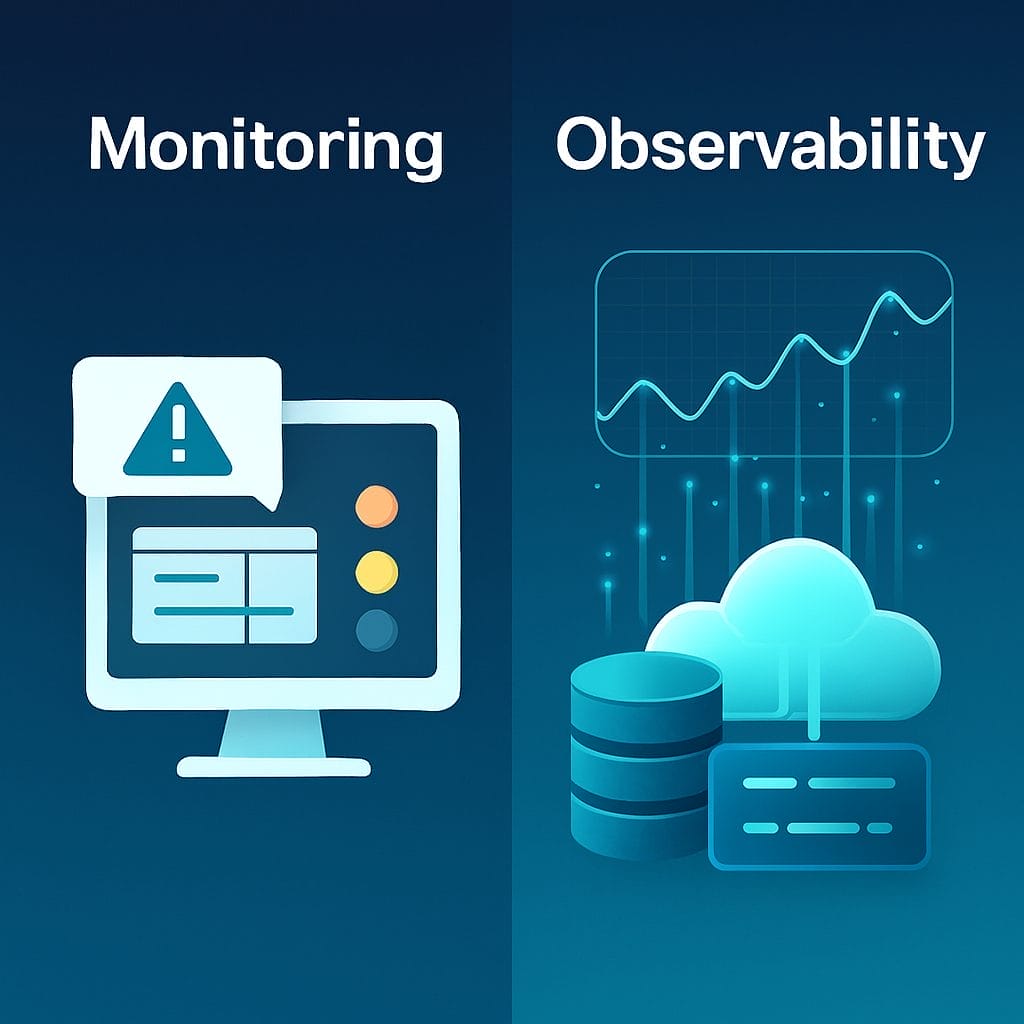
A split image comparing Monitoring, shown by a computer with an alert, and Observability, depicted with graphs, cloud, and database icons—a clear visual for CIOs understanding system oversight.
Monitoring: Necessary but Not Sufficient
Monitoring answers the question: “Is the system up or down?”
It tracks metrics, logs, and alerts. But when something breaks — a slow query, a cost spike, a compliance anomaly — monitoring stops short. Teams know what is wrong, but not why.
Observability: The “Why” Behind the Problems
Observability expands the lens by correlating signals across workloads, databases, and infrastructure. Instead of just flagging symptoms, it gives IT leaders the ability to diagnose root causes — whether it’s an inefficient SQL query, a misconfigured index, or a workload spike in a critical billing or trading system.
For CIOs and CTOs, the difference is not academic:
-
In financial services, seconds of latency can mean lost trades and compliance violations.
-
In healthcare, a delay in EHR queries can impact patient care decisions.
Where Enteros Differentiates
Most monitoring and observability platforms stop at detection. They deliver dashboards and alerts, but leave root-cause analysis — and its business impact — to IT teams.
Enteros goes further:
-
Causation analysis at scale: Pinpoints the SQL queries or workloads driving latency and cloud waste.
-
FinOps integration: Links performance inefficiencies directly to cloud cost optimization, giving CIOs clear cost attribution.
-
Compliance enablement: Generates audit-ready logs and flags anomalies early — before regulators or auditors do.
This combination means IT leaders don’t just see problems — they resolve them faster, with measurable savings and stronger compliance posture.
Business Impact
Enteros helps enterprises:
-
Reduce latency → Faster access to trading systems, EHRs, and billing platforms.
-
Optimize cloud spend → 15–30% savings by eliminating hidden database inefficiencies.
-
Strengthen compliance → Early anomaly detection reduces audit risks and potential fines.
-
Accelerate innovation → Less time firefighting, more time building new AI and data-driven products.
Conclusion
Monitoring will always be part of IT operations — but in today’s high-stakes environment, it’s only the starting point.
Observability with root cause analysis at the database layer gives CIOs and CTOs the visibility and control they need to reduce costs, improve performance, and stay compliant.
Enteros provides CIOs and CTOs with capabilities to reduce latency, optimize cloud spend, and automate compliance — going beyond what traditional monitoring platforms typically deliver.
Frequently Asked Questions
Q1: How is observability different from monitoring?
Monitoring tracks system health and uptime, while observability provides insight into why problems occur by correlating logs, metrics, and traces.
Q2: Why is observability critical for financial services?
Because milliseconds of latency can mean millions in lost trades, observability helps diagnose and resolve bottlenecks in trading, billing, and risk management databases.
Q3: How does Enteros support compliance in healthcare IT?
Enteros provides audit-ready logs and early anomaly detection to align with HIPAA, GDPR, and HITRUST — preventing compliance breaches before audits uncover them.
Q4: Will observability help reduce cloud costs?
Yes. By linking inefficiencies directly to cloud spend, observability with FinOps integration ensures resources are optimized and budgets stay predictable.
Q5: What makes Enteros different from other observability platforms?
Unlike tools that stop at alerts, Enteros delivers root cause analysis at the database layer — directly tying performance to cost and compliance impact.
The views expressed on this blog are those of the author and do not necessarily reflect the opinions of Enteros Inc. This blog may contain links to the content of third-party sites. By providing such links, Enteros Inc. does not adopt, guarantee, approve, or endorse the information, views, or products available on such sites.
Are you interested in writing for Enteros’ Blog? Please send us a pitch!
RELATED POSTS
How Can Enterprises Reduce Database Costs Without Sacrificing Performance?
- 11 September 2026
- Database Performance Management
Enterprises can reduce database costs without sacrificing performance by identifying inefficient SQL, right-sizing infrastructure, eliminating unused capacity, analyzing workload patterns, improving storage efficiency, and using database observability to connect resource consumption with application performance. Database cost optimization helps organizations control infrastructure spending while Enteros UpBeat provides performance intelligence, workload visibility, predictive analytics, and Cloud FinOps … Continue reading “How Can Enterprises Reduce Database Costs Without Sacrificing Performance?”
How Can AI Detect Database Performance Anomalies Before They Cause Downtime?
AI can detect database performance anomalies by continuously analyzing workload patterns, SQL behavior, latency, resource usage, waits, and historical baselines. AI database anomaly detection helps identify unusual behavior before it becomes a larger outage. With Enteros UpBeat, IT teams can detect emerging issues earlier, investigate root causes faster, and improve database reliability across complex enterprise … Continue reading “How Can AI Detect Database Performance Anomalies Before They Cause Downtime?”
How Can Financial Institutions Detect Database Bottlenecks Before Transaction Delays Occur?
- 10 September 2026
- Database Performance Management
Financial institutions can detect database bottlenecks before transaction delays occur by continuously monitoring query latency, database waits, CPU, memory, I/O, locking, workload changes, and transaction throughput. By combining performance baselines, anomaly detection, SQL intelligence, predictive analytics, and automated root cause analysis, teams can identify emerging issues early and optimize databases before customer-facing banking, payment, or … Continue reading “How Can Financial Institutions Detect Database Bottlenecks Before Transaction Delays Occur?”
What Role Does AI-Powered Database Monitoring for Banking Play in Performance Management?
AI-powered database monitoring for banking helps financial institutions detect anomalies, identify performance bottlenecks, analyse SQL workloads, predict capacity risks, and accelerate troubleshooting. By combining database observability with automated analysis, AI-powered database performance supports faster incident response, more reliable transactions, better resource utilisation, stronger capacity planning, and smarter cloud cost decisions across increasingly complex banking database … Continue reading “What Role Does AI-Powered Database Monitoring for Banking Play in Performance Management?”