SQL Backup
I’m sure everyone has heard the adage, “Time and tide wait for no man,” or the more famous saying by Benjamin Franklin, “Never put off until tomorrow what you can do today.” However, it is difficult not to contemplate deferring housework, postponing date night, or even deferring job projects these days. The list of things to accomplish keeps expanding.
Data silos and infrastructure complexities easily overwhelm IT. Therefore project prioritizing approaches are no longer sufficient. Everyone takes on more projects and will postpone some jobs until tomorrow. As a result, the following question arises:
Would you sacrifice data availability if you could spend more time on high-priority tasks and offload some of your SQL Backup Server database backup initiatives?
Backup as a Service for SQL Databases
Cohesity recently established a strategic partnership with Amazon Web Services (AWS) to provide data management (or DMaaS). DMaaS delivers a straightforward approach for corporations and small businesses to back up, secure, administer, and analyze data. Cohesity DataProtect as a Service is the first DMaaS product. It provides cloud backup for various data sources, including virtual machines, NAS and files, and even business databases like Microsoft SQL Server.
But why would anyone want to move SQL Server backup to the cloud in the first place? Cohesity DataProtect as a Service, on the other hand, is a hands-off approach to database backups. The built-in auto-protect feature allows you to set it and forget it. If you select auto-protect, it will apply the same protection policy to all new databases created in the SQL Server instance.
Cohesity supports all SQL Server database recovery models, so you can rest confident that it will fully help any SQL Server database backups you want to offload. So, if your backup and DBA teams are overworked, why not try Cohesity DMaaS?

Getting Started — Back Up SQL Using DataProtect Delivered as a Service
There are three simple steps to using Cohesity DataProtect provided as a Service to safeguard your SQL Server databases once you’ve signed up for a free trial or subscribed to our commercial service and activated your account. We’ll demonstrate how simple it is to move SQL Server backups to the cloud. These are the three steps:
- Create a source. SQL Server is a database management system.
- Must protect a SQL Server database.
- To restore a SQL Server database, follow these steps.
1. Register a Source SQL Server
Select Register Source and MS SQL Backup Server from the Cohesity Helios Sources page. Complete the following steps in the Register an MS SQL Server wizard:
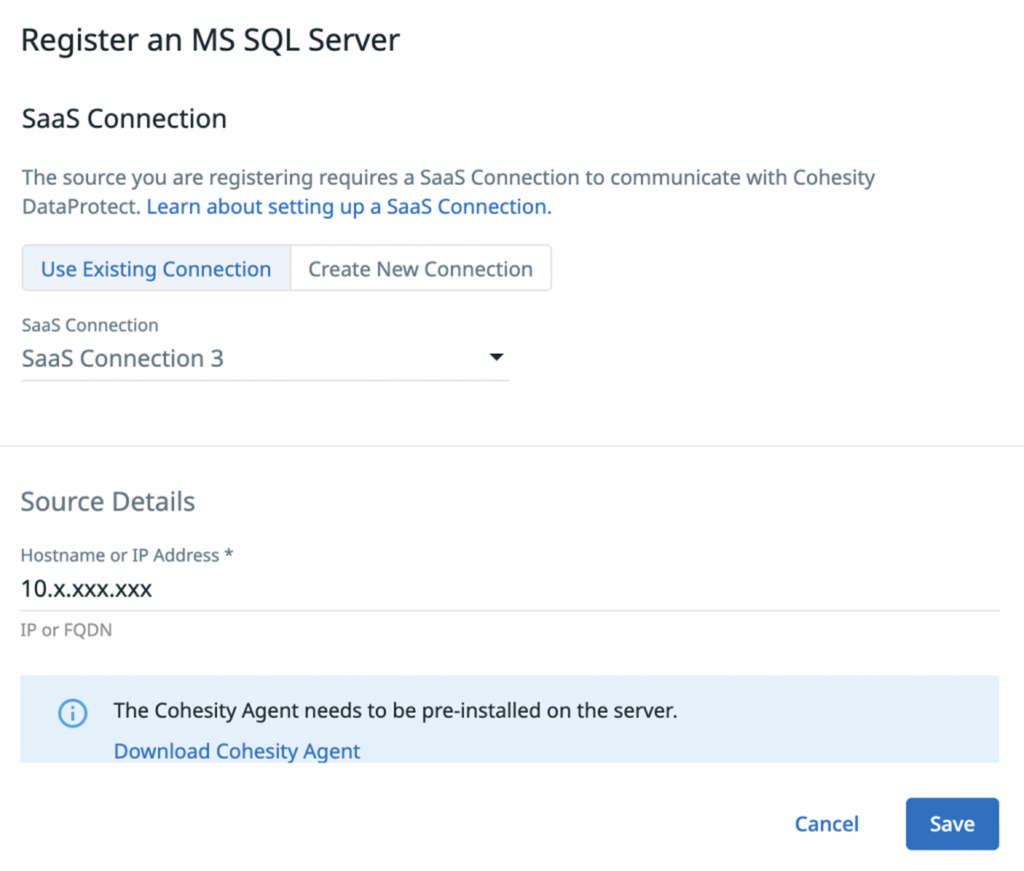
- Make use of an existing SaaS connection or set up a new one. \
- On the SQL Server, download and install the Cohesity Agent.
- Provide the source SQL Server’s FQDN.
When you’ve finished filling out all of the Register an MS SQL Server page information, click Save. Cohesity Helios for SQL Server will register and dynamically find all SQL Server instances and databases linked with the source with a single button click. The goal of the source registration workflow has always been to keep things as easy as possible.
2. Protect a SQL Server Database
The advantages of using the auto-protect option or selecting a specific database base item are now available with Cohesity Helios on the Sources page. Following choosing the database items to be secured, the following step is to pick or create a new policy. The frequency and retention time of the protected object are determined by a Cohesity Helios policy (s).
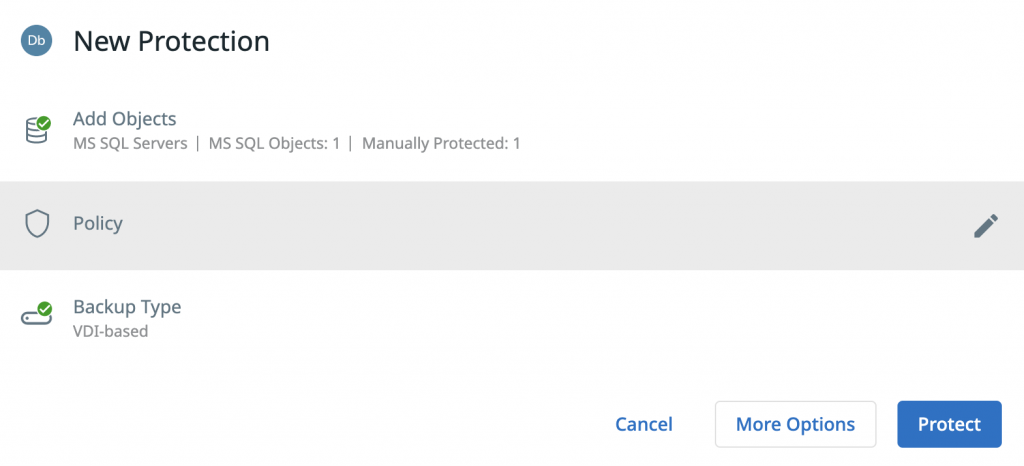
Everything we have to do now is click Protect, and you’re done. You’ve just finished creating a database protection task for SQL Server.
3. Restore a SQL Server Database
It’s just as simple to restore a database object. In the SQL Server source, look for the database. A default list of database actions appears when you click the Activity button. From the three horizontal dots on the far right of the GUI, choose Recover and then Cohesity. The Helios Recover wizard will walk you through recovering the SQL Server database object.
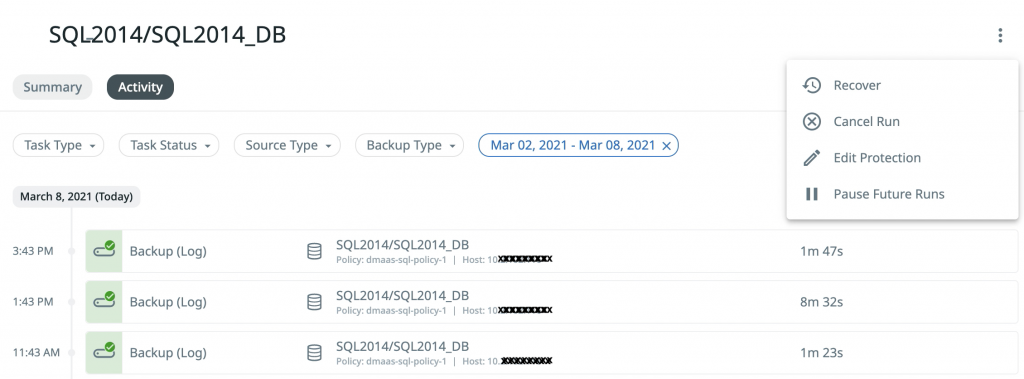
Cohesity Helios comes with all of the recovery features found in Cohesity On-Prem. Using the Recover wizard, finish restoring the database.
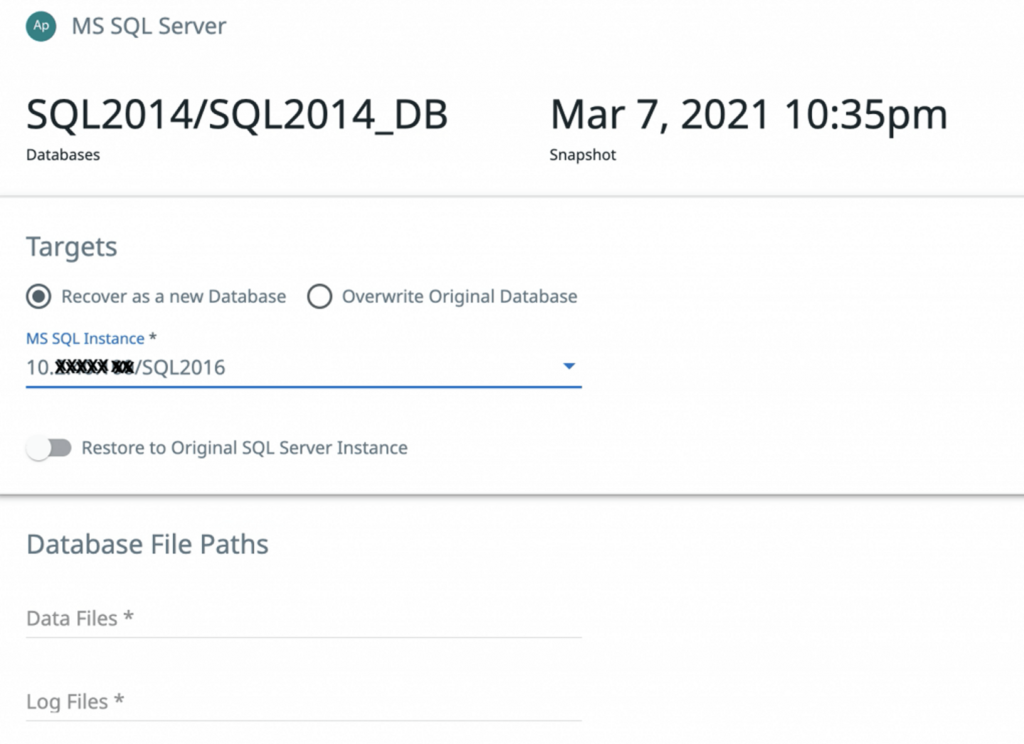
Click Start Recovery at the bottom of the UI page.
The SQL Server database object restoration operation will run and finish. It’s that simple.
Follow these three simple steps to back up and safeguard your SQL Server databases to the cloud.
Now is the Time for Cloud Backup for SQL
When it comes to backing up some of your databases to the cloud, the choice has never been easier with Cohesity DataProtect provided as a Service. It is both extensive and adaptable. You can choose which SQL Server database objects to migrate to the cloud and which to keep on-premises.
Imagine having a to-do list with many items marked off so you can focus on what matters most to you and your company: data access management.
Enteros
About Enteros
IT organizations routinely spend days and weeks troubleshooting production database performance issues across multitudes of critical business systems. Fast and reliable resolution of database performance problems by Enteros enables businesses to generate and save millions of direct revenue, minimize waste of employees’ productivity, reduce the number of licenses, servers, and cloud resources and maximize the productivity of the application, database, and IT operations teams.
The views expressed on this blog are those of the author and do not necessarily reflect the opinions of Enteros Inc. This blog may contain links to the content of third-party sites. By providing such links, Enteros Inc. does not adopt, guarantee, approve, or endorse the information, views, or products available on such sites.
Are you interested in writing for Enteros’ Blog? Please send us a pitch!
RELATED POSTS
How Can Enterprises Reduce Database Costs Without Sacrificing Performance?
- 11 September 2026
- Database Performance Management
Enterprises can reduce database costs without sacrificing performance by identifying inefficient SQL, right-sizing infrastructure, eliminating unused capacity, analyzing workload patterns, improving storage efficiency, and using database observability to connect resource consumption with application performance. Database cost optimization helps organizations control infrastructure spending while Enteros UpBeat provides performance intelligence, workload visibility, predictive analytics, and Cloud FinOps … Continue reading “How Can Enterprises Reduce Database Costs Without Sacrificing Performance?”
How Can AI Detect Database Performance Anomalies Before They Cause Downtime?
AI can detect database performance anomalies by continuously analyzing workload patterns, SQL behavior, latency, resource usage, waits, and historical baselines. AI database anomaly detection helps identify unusual behavior before it becomes a larger outage. With Enteros UpBeat, IT teams can detect emerging issues earlier, investigate root causes faster, and improve database reliability across complex enterprise … Continue reading “How Can AI Detect Database Performance Anomalies Before They Cause Downtime?”
How Can Financial Institutions Detect Database Bottlenecks Before Transaction Delays Occur?
- 10 September 2026
- Database Performance Management
Financial institutions can detect database bottlenecks before transaction delays occur by continuously monitoring query latency, database waits, CPU, memory, I/O, locking, workload changes, and transaction throughput. By combining performance baselines, anomaly detection, SQL intelligence, predictive analytics, and automated root cause analysis, teams can identify emerging issues early and optimize databases before customer-facing banking, payment, or … Continue reading “How Can Financial Institutions Detect Database Bottlenecks Before Transaction Delays Occur?”
What Role Does AI-Powered Database Monitoring for Banking Play in Performance Management?
AI-powered database monitoring for banking helps financial institutions detect anomalies, identify performance bottlenecks, analyse SQL workloads, predict capacity risks, and accelerate troubleshooting. By combining database observability with automated analysis, AI-powered database performance supports faster incident response, more reliable transactions, better resource utilisation, stronger capacity planning, and smarter cloud cost decisions across increasingly complex banking database … Continue reading “What Role Does AI-Powered Database Monitoring for Banking Play in Performance Management?”