Preamble
If you mainly use open-source programs in your company, and there are several MS SQL server databases, you can consider moving to a MySQL database.
Below are a few reasons why you might want to consider migrating Microsoft SQL Server to a MySQL database:
- In order to avoid huge licenses and support for MS SQL Server. In MySQL, even if you decide to use the corporate version of MySQL, it is cheaper.
- Unlike SQL Server, MySQL supports a wide range of operating systems, including several Linux, Solaris, and Mac distributions.
- To implement a scalable database infrastructure.
- In order to take advantage of several additional features of a MySQL database, which have been tested over many years by a huge open source.
Move an MS SQL database to MySQL using the “MySQL Workbench” utility module
The easiest way to install MySQL Workbench is to install “Oracle MySQL for Windows”, which installs several MySQL tools including Workbench.
Download and install the MySQL Installer, which includes the Workbench and other necessary modules and drivers you need for migration.
The steps required to migrate an MSSQL database to MySQL using the Workbench Migration Wizard
1. Take care of the necessary conditions
Before running the MySQL database migration wizard in the toolbox, we need to make sure that ODBC drivers are present to connect to the original Microsoft SQL Server database as they are not supplied with the Workbench.
Make sure that the max_allowed_packet option in MySQL Server is large enough for the migration.
Make sure that we can connect to both the target MySQL server database and the source MSSQL Server database with the appropriate privileges that are necessary for the data migration.
In the MySQL Workbench, the Migration Wizard will display the following “Migration task list” that you need to go through to finish the migration process.
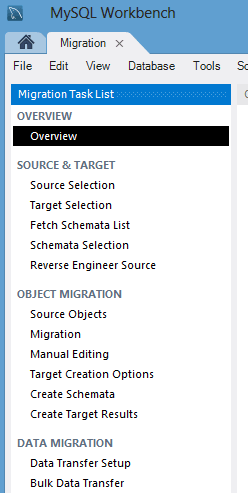
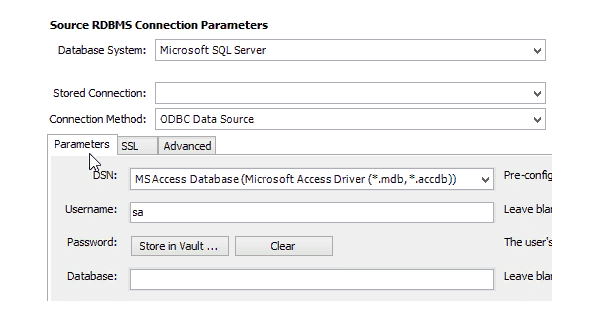
2. Selecting the source and target database
First, define the connection options for the initial Microsoft SQL Server database. Select “Microsoft SQL Server” from the drop-down list of database systems. On the Options tab, select DSN and specify the user name in the database.
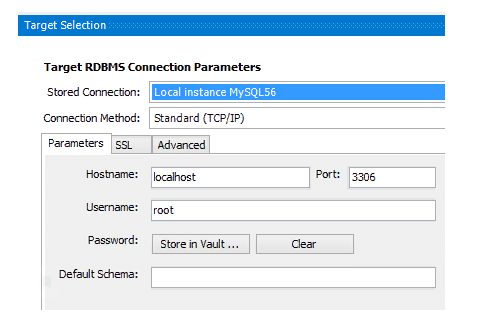
Next, define a target connection to a MySQL database in the Options tab. Select “Local MySQL instance” or “Remote MySQL instance” depending on the situation.
On the Options tab, enter the hostname or IP address of the MySQL database, MySQL port, and user name. If you do not specify a password, he will offer you.
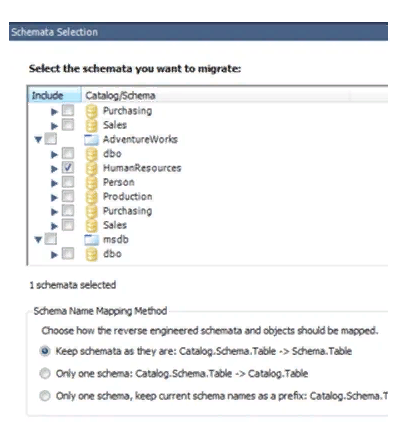
After you specify the source and destination, all available schemes and databases will be listed.
You can select a specific schema that you like, migrate (or select all), and you can also specify a custom schema mapping in the target MySQL database.
3. Transfer of objects
At this step, Microsoft SQL Server schema objects, table objects, data types, default values, indexes, primary keys are converted.
Note that the view object, functioning objects and stored procedures are simply copied and commented on, we will need to convert them manually.
4. Data Migration
At this stage, the automated copy of data is made from the source to the target database for the transferred tables.
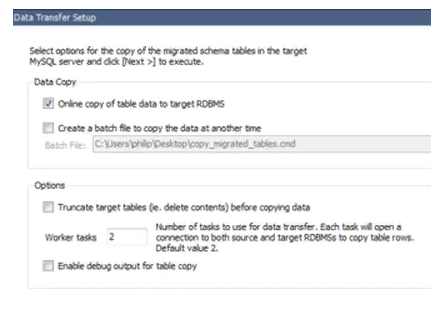
Note that with the Migration Wizard, we can only convert tables and copy data, but cannot convert triggers, views and stored procedures.
We have to do this manually, we could cover this in a future article on how to transfer stored procedures from MS SQL to MySQL.
About Enteros
Enteros offers a patented database performance management SaaS platform. It proactively identifies root causes of complex business-impacting database scalability and performance issues across a growing number of clouds, RDBMS, NoSQL, and machine learning database platforms.
The views expressed on this blog are those of the author and do not necessarily reflect the opinions of Enteros Inc. This blog may contain links to the content of third-party sites. By providing such links, Enteros Inc. does not adopt, guarantee, approve, or endorse the information, views, or products available on such sites.
Are you interested in writing for Enteros’ Blog? Please send us a pitch!
RELATED POSTS
Using Predictive AIOps and FinOps to Improve Healthcare Application Reliability
- 26 August 2026
- Database Performance Management
Introduction Healthcare organizations increasingly depend on digital applications to support patient care, clinical workflows, administrative operations, and data-driven decision-making. Electronic health record (EHR) systems, telehealth platforms, patient portals, diagnostic applications, insurance systems, laboratory platforms, and healthcare analytics solutions all require reliable and responsive IT infrastructure. As these applications become more connected and data-intensive, maintaining reliability … Continue reading “Using Predictive AIOps and FinOps to Improve Healthcare Application Reliability”
How to Optimize Higher Education Technology with Enteros Database Software, AIOps, and Cloud FinOps
Introduction Universities and higher education institutions are undergoing rapid digital transformation. Learning Management Systems, student portals, online examinations, digital libraries, research platforms, admissions systems, finance applications, and campus management platforms have become essential infrastructure. At the same time, higher education organizations are under pressure to manage technology budgets carefully. Read more”Indian Country” highlights Enteros and … Continue reading “How to Optimize Higher Education Technology with Enteros Database Software, AIOps, and Cloud FinOps”
How AIOps and FinOps Strengthen Digital Healthcare Infrastructure and Cost Efficiency
Introduction The healthcare industry is undergoing one of the most significant digital transformations in its history. Hospitals, healthcare providers, insurance organizations, telehealth platforms, diagnostic centers, and healthcare technology companies increasingly rely on digital systems to deliver patient care, manage medical records, process claims, support remote consultations, and analyze clinical data. As healthcare organizations embrace cloud … Continue reading “How AIOps and FinOps Strengthen Digital Healthcare Infrastructure and Cost Efficiency”
How to Optimize Real Estate Technology Operations with Enteros Database Software, AI-Powered Analytics, and Database Observability
Introduction Real estate organizations are becoming increasingly technology-driven. Property management platforms, online listings, tenant applications, leasing systems, CRM, property accounting, smart-building platforms, investment analytics, and digital marketplaces all depend on reliable databases. Real estate businesses also increasingly use AI and analytics to understand property demand, pricing, occupancy, customer behavior, and investment opportunities. Read more”Indian Country” … Continue reading “How to Optimize Real Estate Technology Operations with Enteros Database Software, AI-Powered Analytics, and Database Observability”